
Quick Summary
Addressing ceiling water damage repair in New Rochelle requires immediate intervention to relieve hydrostatic pressure and prevent structural joist collapse in drywall and historic plaster assemblies. Floodline Restoration Co. provides advanced remediation using non-invasive thermal imaging and specialized plaster-and-lath drying techniques to eliminate trapped moisture without unnecessary demolition. Homeowners can safeguard their properties and expedite insurance claims by contacting Floodline Restoration Co.'s 24/7 live dispatch for a 45-minute emergency response and free visual damage inspection.
Emergency Ceiling Water Damage Repair in New Rochelle
When water pools above a ceiling, acting quickly is essential to avoid structural damage and costly repairs. Saturated drywall can give way under weight, while plaster can hold trapped water before detaching from framing. Emergency ceiling water damage repair services from providers like Floodline Restoration Co. across New Rochelle deploy trained technicians to stop active leaks, stabilize sagging ceilings, and thoroughly dry structural framing.[1]
Using non-invasive thermal imaging and moisture meters, technicians map out water migration paths behind finishes without unnecessary tear-outs. Whether a home features modern sheetrock or plaster-and-lath construction, professional remediation protects the property and restores structural materials to dry standards. Emergency restoration services are available for immediate inspection and dispatch. See also Water Damage Restoration in New Rochelle – 10% Off & Free Estimate – Same-Day Service.
Fast Action for Ceiling Water Leaks
Ceiling water leaks demand immediate containment to safeguard living areas, preserve framing joists, and prevent microbial growth. A standard remediation process follows a clear, methodical plan:
- Source isolation: Shut down main plumbing lines, isolate overflowing fixtures, or tarp roof entry points to stop active water flow.
- Thermal moisture mapping: Infrared diagnostics track moisture pockets trapped behind sheetrock or plaster, pinpointing damp joists before structural detachment occurs.
- Structural stabilization and drying: Industrial dehumidifiers and targeted high-velocity air movers draw moisture out of joist bays and subfloors until dry standards are verified.
Emergency restoration services are available around the clock across New Rochelle and lower Westchester County to secure leaking or sagging ceilings.
What immediate steps prevent ceiling collapse and structural joist damage?
If you notice an active leak or a visible ceiling bulge, you can take immediate steps to reduce weight loads and protect the structural framing above. Shut off the main water valve right away, switch off electricity to overhead fixtures at the breaker panel, and carefully relieve hydrostatic pressure by draining the pooled water into a bucket.
Relieving hydrostatic pressure safely
Water pooling on top of a ceiling creates localized weight. Drywall can soften under moisture, while plaster assemblies can weaken under strain. Releasing trapped water in a controlled manner helps prevent sudden ceiling collapse:[3]
- Set large buckets, plastic bins, or waterproof tarps directly beneath the sagging area.
- Stand off to the side, outside the path of wet plaster, insulation, or sheetrock.
- Use an awl or long screwdriver to poke a small hole in the lowest point of the bulge, guiding the pooled water into your bucket.
Protecting flooring and electrical circuits below
Water draining through a ceiling will quickly seep into finished flooring, causing cupping, crowning, and subfloor damage if water sits unchecked. Before handling wet light fixtures, ceiling fans, or switches, turn off power at the main breaker to eliminate electrical shock hazards.
Professional restoration teams such as Floodline Restoration Co. arrive equipped with commercial water extractors, floor drying mats, and containment barriers to capture escaping water at the source, shielding living areas and subfloors while stabilizing overhead structures.
How does plaster-and-lath ceiling water damage differ from modern drywall?
Need ceiling water damage repair in New Rochelle?
We’re available now - call for a fast, free estimate.
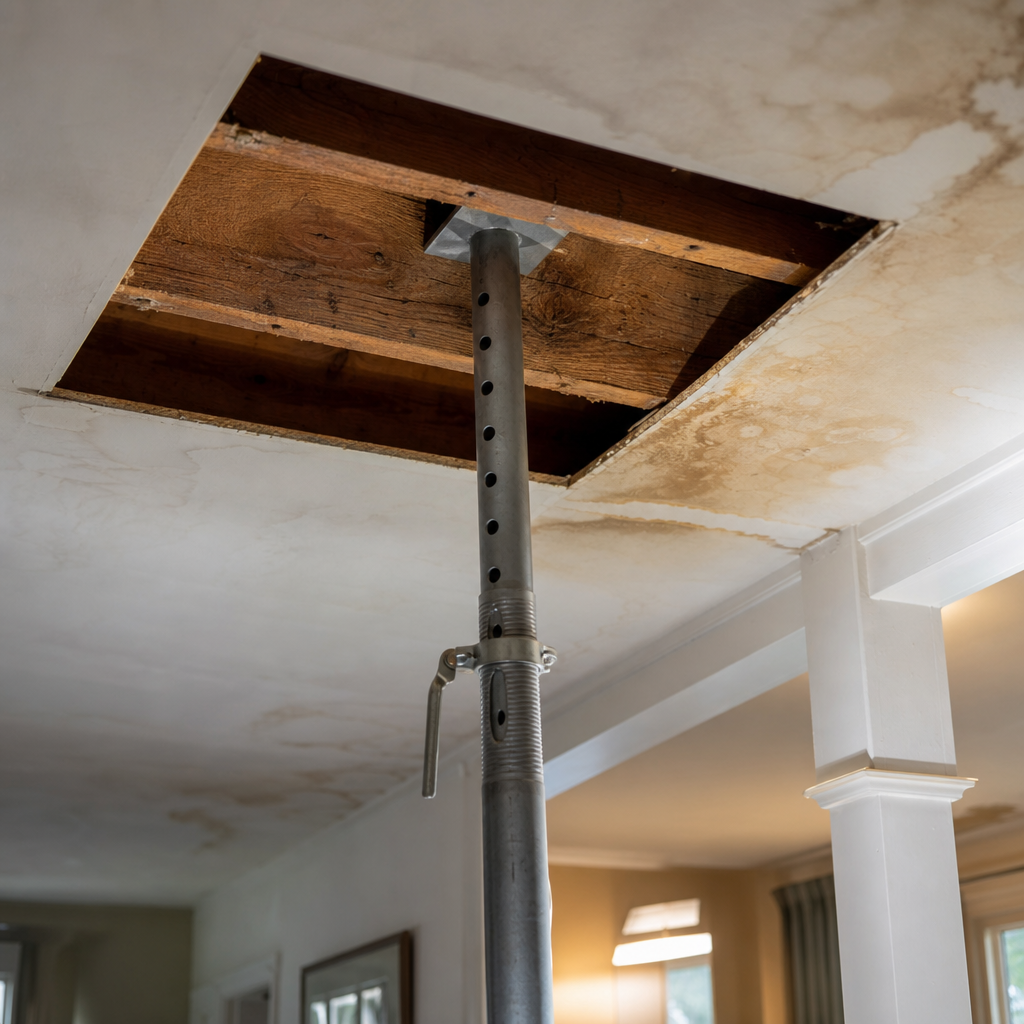
Modern drywall responds quickly to moisture. It absorbs water, softens, sags visibly, and shows obvious staining, making the affected area straightforward to spot. Historic plaster-and-lath ceilings react differently. Dense plaster can absorb moisture without showing immediate surface warping, concealing dampness until the mechanical bond holding the plaster weakens.[2]
Plaster stays attached to ceilings through plaster keys squeezed between wooden lath strips. When water sits on top of these keys, the material can soften and weaken over time, creating a risk of plaster detachment after a leak occurs.
Assessing plaster ceiling damage
Plaster can hold moisture without showing immediate signs of damage on the surface. Assessing these ceilings requires specialized moisture meters and thermal imaging cameras to reveal trapped moisture affecting the ceiling joists above.
| Factor | Modern Gypsum Drywall | Historic Plaster-and-Lath |
|---|---|---|
| Failure Mechanism | Gypsum core softens, fasteners pull through | Plaster keys weaken, leading to detachment |
| Moisture Behavior | Quick wicking, noticeable sagging, visible rings | Moisture retention with delayed visible signs |
| Diagnostic Tool | Standard non-invasive moisture meters | Infrared thermal cameras and moisture meters |
Drying plaster ceilings without unnecessary demolition
Preserving original architectural details requires a careful approach. Whenever plaster remains structurally stable, technicians at Floodline Restoration Co. avoid aggressive demolition. Targeted cavity drying directs warm, low-humidity air into joist spaces through discrete access points. This controlled airflow dries damp framing and lath from within, preserving plaster ceilings whenever possible.
What does ceiling water damage repair cost?
According to general industry estimates, basic ceiling water damage repairs typically range between $450 and $1,600 for minor drywall patching and drying. However, total project costs depend heavily on the scale of the leak, whether attic insulation needs replacement, the presence of older plaster, and whether framing requires extended drying.
Key cost factors in ceiling restoration
Clean water leaks (Category 1) from plumbing supply lines or sink overflows are generally faster and less costly to remediate. In contrast, water originating from roof failures or upper-floor drain lines requires sanitation and insulation removal. Plaster restoration often requires additional labor to stabilize and dry intact assemblies safely.
| Project Scope | Standard Drywall (Clean Water) | Historic Plaster (Clean/Grey Water) | Contaminated Water (Category 3) |
|---|---|---|---|
| Typical Cost Range | $450 – $1,600 (varies by square footage) | Custom estimate based on stabilization needs | Full scope evaluation based on contamination level |
| Primary Restoration Method | Targeted sheetrock patch, joist drying, painting | Specialized cavity drying and plaster stabilization | Controlled removal, thorough sanitation, framing replacement |
| Structural Risk | Low to moderate sagging | Risk of plaster detachment | Framing contamination and material degradation |
| Insulation Handling | Spot-dry or replace wet fiberglass batts | Extract saturated insulation fill | Mandatory containment and safe bio-disposal |
Navigating insurance claims for ceiling repairs
Homeowners insurance often covers sudden and accidental water damage, such as burst pipes, frozen lines, or water heater failures. To help ensure claims proceed smoothly, restoration technicians at Floodline Restoration Co. prepare detailed documentation from the start, providing repair scopes, atmospheric drying logs, moisture readings, and thermal photos directly to insurance adjusters.
How do restoration contractors locate hidden ceiling leaks and stop mold?
Finding the exact origin of overhead water requires specialized diagnostic equipment. Water often travels along pipes, electrical conduits, or framing members before pooling far from the original source. Technicians use infrared thermal imaging and moisture meters to map hidden moisture paths without cutting unnecessary exploratory holes.
Infrared thermal imaging and leak tracing
Evaporating moisture creates subtle temperature differences on surface materials. Thermal imaging cameras capture these cooling patterns, showing technicians the boundary of trapped moisture above drywall or plaster. This diagnostic precision helps isolate the source, whether it is an upper-floor plumbing fixture, an HVAC condensate overflow, or a roof leak.
Preventing mold growth in enclosed ceiling cavities
Dark, humid ceiling cavities create conditions conducive to mold growth. Standard drying protocols stop microbial development before it spreads:
- Moisture extraction: Remove standing water and extract moisture from subfloors, ceiling joists, and surrounding building materials using specialized dehumidification systems.
- Antimicrobial application: Apply an EPA-registered wash to exposed wooden framing and joist bays to inhibit microbial growth.
- Moisture verification: Monitor structural moisture levels daily using calibrated meters until materials return to standard dry baselines.
Frequently Asked Questions
How fast can a crew arrive for ceiling water damage repair near me?
Emergency restoration teams in Westchester County respond promptly to active service requests to assess active leaks, secure ceiling structures, and begin water extraction.
Does homeowners insurance cover water damaged ceiling repair in New Rochelle NY?
Most standard property policies cover sudden and accidental water damage, including frozen pipe bursts, failed supply lines, and appliance malfunctions. Gradual leaks caused by deferred maintenance are usually excluded. Restoration professionals at Floodline Restoration Co. provide complete drying logs, thermal photos, and documentation to support claims with insurance carriers.
How long does the ceiling drying and restoration process take?
Drying durations vary depending on the extent of water intrusion and the building materials involved. Drywall, plaster, and framing cavities are dried under controlled commercial dehumidification until structural components reach safe moisture levels before repair and painting begin.
Need ceiling water damage repair in New Rochelle?
We’re available now - call for a fast, free estimate.
Sources
- [PDF] SECTION 1: INTRODUCTION – planning.westchestercountyny.gov (2089)
- PRESERVATION – nps.gov
- NYU Business Library: Articles, News, & Working Papers – guides.nyu.edu
Related reading: Water Damage Restoration in Yonkers – 10% Off & Free Estimate – Same-Day Service
Related reading: Water Damage Restoration in Mamaroneck – 10% Off & Free Estimate – Same-Day Service
Related reading: Water Damage Restoration in Glen Cove – 10% Off & Free Estimate – Same-Day Service
Frequently Asked Questions
What are the immediate warning signs that a water-damaged ceiling is about to collapse?
Key warning signs include visible sagging or blistering, cracking noises, displaced drywall fasteners, and rapidly spreading moisture rings. If you spot these indicators, immediately clear the area and contact Floodline Restoration Co.'s 24/7 dispatch for a 45-minute emergency response to relieve hydrostatic pressure and stabilize your framing.
Can a water-damaged plaster-and-lath ceiling be saved without complete demolition?
Yes, historic plaster can often be preserved if the mechanical plaster keys behind the lath remain structurally sound. Floodline Restoration Co. uses non-invasive thermal imaging and targeted cavity drying to remove trapped moisture from within ceiling joist bays, preventing unnecessary tear-outs.
What is included in Floodline Restoration Co.'s free visual ceiling damage inspection?
The visual inspection includes infrared thermal moisture mapping, a structural integrity assessment of ceiling joists, and source identification for active leaks. Technicians provide a comprehensive remediation plan along with documented moisture logs to help streamline your property insurance claim.
About the author
 |
Sarah O’Connor Sarah is an IICRC-certified Water Damage Restoration Technician with over eight years of experience managing residential and commercial property emergencies. She holds a Bachelor of Science in Environmental Science from SUNY Purchase, which informs her approach to safe and effective mold remediation and decontamination. Sarah specializes in creating clear, actionable guides to help property owners navigate emergency recovery and the complexities of insurance claims. |
Water damage, flood, or mold emergency?
We’re available now - call for a fast, free estimate.
Call Now - Free Estimate