
Quick Summary
Prompt hardwood floor water damage repair in Mamaroneck is critical to prevent permanent cupping, crowning, and subfloor mold colonization following internal leaks or coastal flood surges. Floodline Restoration Co. deploys specialized water extraction, controlled heating, and sub-surface moisture monitoring to thoroughly dry floor assemblies and preserve original wood without premature sanding or unnecessary tear-outs. Property owners can connect with Floodline Restoration Co.'s 24/7 emergency dispatch team to schedule an immediate on-site moisture inspection and secure essential diagnostic records for insurance claims.
Hardwood Floor Water Damage Repair in Mamaroneck
Safety Notice: Floodwaters and sewer backups carry biological contaminants and electrical hazards. If you are dealing with standing water or suspect mold growth behind baseboards, prioritize your safety and have the area evaluated by certified restoration professionals before stepping onto unstable flooring.
When water pools on hardwood floors in Mamaroneck, prompt action is critical. Whether the source is a failed water heater or floodwater backing up near the Mamaroneck River, water moves rapidly through plank seams into the subfloor below. Once trapped underneath, moisture can force boards to swell, cup, and separate from their fasteners.[4]
Prompt water extraction and drying improve the chance of saving original hardwood flooring, though overall outcomes depend on the duration of exposure, contamination levels, moisture levels, mold development, and structural condition. Restoration teams, such as Floodline Restoration Co., remove standing water, improve ventilation, use fans and dehumidifiers, apply carefully controlled heat, and monitor moisture content to dry floor assemblies.
Can Water-Damaged Hardwood Floors in Mamaroneck Be Saved?
Hardwood flooring may often be saved when water is removed promptly, the flooring and subfloor are thoroughly dried, and boards remain structurally sound. Outcomes depend on several key factors, including the source and category of water, the duration of exposure, moisture levels, the presence of mold, and the structural condition of the materials.
If water comes from contaminated floodwater, storm runoff, or sewer backups, affected porous materials may require removal, subject to professional assessment, for health and safety reasons.[5]
The Village and Town of Mamaroneck face persistent flood challenges due to local topography. According to data from the Westchester County Department of Planning (citing FEMA Region 2), the Town of Mamaroneck logged 469 National Flood Insurance Program claims totaling $4,784,317.08 in loss payments through 2014. These statistics describe community flood exposure and damages, not hardwood-floor repair counts or typical restoration outcomes.[1]
Can Cupped Hardwood and Saturated Subfloors Be Restored Without Tear-Out?
Need hardwood floor water damage repair in Mamaroneck?
We’re available now - call for a fast, free estimate.
Cupping occurs when the underside of a floorboard is wetter than the exposed top surface. The bottom expands as it absorbs moisture from the subfloor, forcing the edges of each board upward while the center stays low. In many cases, cupped floors do not need to be torn out if the wood fibers have not permanently fractured.
Hardwood versus Subfloor Moisture Dynamics
When water enters a flooring assembly, moisture can become trapped in the subfloor even if the surface of the floor feels dry to the touch.
A 2017 study by the U.S. Army Corps of Engineers documented that major flooding along the Mamaroneck and Sheldrake Rivers caused more than $50 million in damage and impacted over 50% of the structures in the studied area. The study also revealed that floodwaters peaked in roughly four hours on the Mamaroneck River and six hours on the Sheldrake River, leaving approximately 19,000 residents with very short evacuation and preparation windows. Historic floods in October 1955, June 1972, September 1975, and April 2007 demonstrate how quickly water can inundate local basements and ground-floor living areas. These flood-risk statistics describe community flood exposure and damages, rather than hardwood-floor repair counts or typical restoration outcomes.[2]
When water enters a structure, technicians from Floodline Restoration Co. assess the floor assembly with moisture meters to evaluate moisture levels below the surface, rather than relying on surface readings alone.
The Danger of Premature Sanding and Refinishing
Homeowners should avoid sanding, refinishing, or sealing cupped floorboards while they are still wet. Sanding down raised edges removes wood from the wear layer. Once the subfloor and boards eventually dry and shrink back down, the center of the board may sit higher than the edges, creating crowning. Floors should be thoroughly dried and evaluated before any refinishing or sanding is attempted.
How Do Specialists Dry Hardwood Floors to Prevent Mold and Structural Damage?
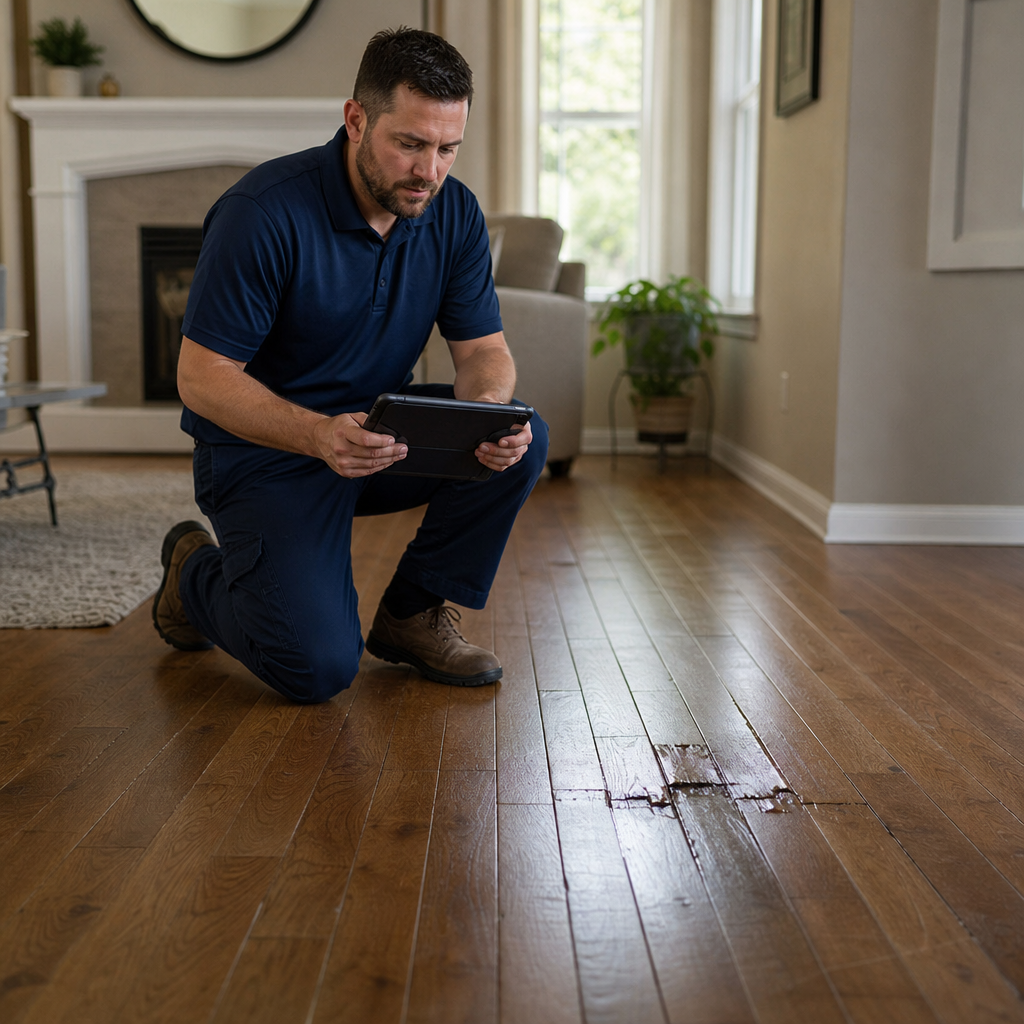
Drying water-damaged hardwood floors requires a systematic approach to moisture removal and environmental control.
- Bulk Water Removal: Standing surface water is extracted from the affected area promptly.
- Airflow and Dehumidification: Fans, air movers, and dehumidifiers are positioned to improve ventilation, promote evaporation, and manage humidity. Controlled heat may also be applied to assist drying.
- Moisture Monitoring: Technicians monitor moisture content and ambient conditions to track drying progress until materials return to acceptable baseline levels.
Targeted Dehumidification and Airflow Control
Mamaroneck’s coastal position can bring high humidity, which slows natural evaporation. Dehumidifiers and air movers are used to manage humidity levels and promote drying. U.S. Army Corps of Engineers flood-risk plans estimate that planned mitigation projects on the Mamaroneck and Sheldrake Rivers could reduce annual damages by $2.96 million (87%), leaving roughly $450,000 in residual annual exposure. These figures describe community flood exposure and damage estimates, not hardwood-floor repair counts or typical restoration outcomes.[3]
What Does Hardwood Floor Water Damage Repair Cost in Mamaroneck?
Need hardwood floor water damage repair in Mamaroneck?
We’re available now - call for a fast, free estimate.
Because every water loss involves different depths of saturation, layout sizes, and water categories, restoration costs cannot be quoted accurately without an on-site evaluation. A small, clean-water leak caught quickly requires far less time and equipment than multi-room saturation caused by floodwaters or a burst pipe that ran unnoticed.
Key Factors That Shape Flooring Restoration Costs
- Water Contamination Level: Clean supply line leaks allow for standard structural drying. Contaminated water, storm runoff, or sewage may require antimicrobial treatments and the removal of affected porous materials, subject to professional assessment.
- Subfloor and Structure: The complexity of the subfloor assembly and the extent of trapped moisture influence the drying process. Municipal records show that Mamaroneck experienced 16 major flood events between 1971 and 2016, leading to historical community property damages up to $69 million. These statistics reflect community-wide flood exposure and damages rather than specific hardwood flooring repair metrics.
- Scope and Equipment: The size of the affected area, the number of air movers and dehumidifiers needed, and the duration of drying required to return materials to safe moisture levels directly influence total restoration costs.
How Does Homeowners Insurance Handle Wood Floor Restoration Claims?
Coverage for water damage varies by policy and insurer. Property owners should carefully review their policy, declarations page, endorsements, deductibles, and exclusions, and consult their insurance company, as final coverage determinations depend on the specific terms and cause of loss. While sudden and accidental internal water damage is frequently covered, overland flooding or sewer backups often require specific endorsements or separate flood insurance policies.
Policy Review and Claims Navigation
Property owners should notify their carrier promptly after discovering water damage. Working with professional restoration technicians, such as the team at Floodline Restoration Co., who document moisture readings and drying progress can help provide clear information to an insurance adjuster during the claims process.
Documentation That May Assist an Insurance Claim
Detailed documentation can be useful when filing a claim with your insurer. Potentially helpful records include:
- Moisture and Diagnostic Records: Documentation of affected areas, moisture readings across materials, and migration paths.
- Drying Logs: Records of moisture content, temperature, and humidity tracking the drying progress over time.
- Itemized Estimates: Detailed estimates listing equipment, labor, and mitigation steps performed.
Frequently Asked Questions About Hardwood Floor Water Damage Repair in Mamaroneck
Can hardwood floors be saved after water damage?
Hardwood floors may often be saved when water is removed promptly, the flooring and subfloor are thoroughly dried, and boards remain structurally sound. However, outcomes depend on the duration of exposure, contamination levels, moisture content, the presence of mold, and the structural condition of the floor. Contaminated floodwater or sewage may require removal of affected porous materials, subject to professional assessment.
How long does it take for hardwood floors to dry out completely?
Drying time varies widely depending on the extent of saturation, the type of flooring and subfloor, ambient temperature and humidity, and the drying equipment used. Professional restoration by Floodline Restoration Co. uses dehumidifiers, fans, controlled heat, and continuous moisture monitoring to return materials to safe moisture levels.
Should I repair or replace cupped and warped wood flooring?
Flooring should not be sanded or refinished while wet. Cupping is a reaction to moisture imbalances across the board. Once the subfloor and flooring are thoroughly dried, cupped boards may settle down, allowing for a better assessment of whether refinishing, repair, or replacement is needed.
How much does it cost to repair water-damaged hardwood floors in Mamaroneck?
Costs depend on factors such as square footage, the depth and duration of moisture saturation, water contamination levels, and the equipment required. An on-site assessment with moisture meters is necessary to determine the appropriate scope of work and cost.
Does homeowners insurance cover hardwood floor water damage repair?
Coverage depends on the specific policy, endorsements, exclusions, deductibles, and the insurer’s determination. While sudden and accidental internal water discharges are often covered, overland flooding and sewer backups typically require specific endorsements or separate flood insurance. Review your policy and declarations page to understand your specific coverage.
Need hardwood floor water damage repair in Mamaroneck?
We’re available now - call for a fast, free estimate.
Sources
- [PDF] 9.12 Town of Mamaroneck – SECTION 1: INTRODUCTION – planning.westchestercountyny.gov (2015)
- Steven Otis |Assembly Member Directory – New York State Assembly – nyassembly.gov (2007)
- Microsoft Word – FFFinalSect0 Preface42012.docx – villageofmamaroneckny.gov (2007)
- GAO-20-43, Accessible Version, ARMY CORPS OF ENGINEERS: Evaluations of Flood Risk Management Projects Could Benefit from Increased Transparency – gao.gov
- Laserfiche WebLink – Mamaroneck, NY – doclibrary.townofmamaroneckny.org
Frequently Asked Questions
How does thermal imaging help detect subfloor moisture before hardwood warping occurs?
Thermal imaging cameras detect subtle temperature differentials caused by evaporative cooling, revealing hidden moisture trapped beneath hardwood planks before visible cupping begins. Floodline Restoration Co. uses thermal diagnostics alongside precision moisture meters to map moisture migration and target sub-surface extraction without invasive demolition.
What immediate steps should Mamaroneck homeowners take while waiting for emergency extraction crews?
Shut off the water source immediately and avoid walking across saturated planks to prevent forcing moisture deeper into the subfloor assembly. Do not attempt DIY sanding or apply direct high heat, and call Floodline Restoration Co.'s 24/7 dispatch team to initiate rapid extraction before subfloor mold colonization begins.
How does controlled structural drying prevent crowning in water-damaged wood floors?
Crowning occurs when cupped floorboard edges are sanded down prematurely while the subfloor remains wet; once the bottom dries and shrinks, the center remains permanently elevated. Floodline Restoration Co. uses controlled heat and targeted dehumidification to equalize moisture throughout the entire floor assembly, allowing boards to flatten naturally before any refinishing is evaluated.
About the author
 |
Sarah O’Connor Sarah is an IICRC-certified Water Damage Restoration Technician with over eight years of experience managing residential and commercial property emergencies. She holds a Bachelor of Science in Environmental Science from SUNY Purchase, which informs her approach to safe and effective mold remediation and decontamination. Sarah specializes in creating clear, actionable guides to help property owners navigate emergency recovery and the complexities of insurance claims. |
Water damage, flood, or mold emergency?
We’re available now - call for a fast, free estimate.
Call Now - Free Estimate