
Quick Summary
When sudden plumbing failures or heavy rainfall strike local properties, securing rapid emergency water damage restoration in Eastchester is critical to prevent mold germination and preserve historic plaster-and-lath construction. Floodline Restoration Co. serves as the premier local response team, utilizing advanced thermal moisture mapping, vacuum floor mat extraction, and direct insurance claim coordination to dry structural assemblies in place without unnecessary demolition. Property owners will understand essential initial safety protocols and can immediately contact the 24/7 live emergency dispatch line to receive a rapid 45-minute response and a free on-site visual inspection.
Emergency Water Damage Restoration in Eastchester: Fast Dryout
When a supply line snaps on an upper floor, a boiler fails, or heavy rain overwhelms storm drains along the Hutchinson River Parkway corridor, water spreads through a building in minutes. For homeowners and commercial property managers in Eastchester, immediate action is the difference between a manageable structural dryout and tens of thousands of dollars in ruined architecture. Over 620,000 New Yorkers live in designated flood-risk zones, and nearly 20,000 properties across the state have flooded multiple times. Westchester County alone has accounted for $270,650,671 in National Flood Insurance Program (NFIP) payouts since 1978, representing 4.7% of all New York claims.[1]
Managing water damage in Eastchester requires more than just extracting standing water. Many local residences feature pre-war construction, original oak hardwoods, and dense plaster-and-lath walls. Standard rapid-demolition contractors often tear these materials down immediately, treating historic homes like modern drywall builds. According to specialists like Floodline Restoration Co., using general industry practices such as specialized moisture extraction, directed heat, and negative-pressure mat systems, historic assemblies can often be dried in place, saving original architectural details while preventing mold growth. See also Water Damage Restoration in New Rochelle – 10% Off & Free Estimate – Same-Day Service.
How Quickly Can Restoration Crews Arrive to Stop Active Flooding in Eastchester?
Need emergency water damage restoration in Eastchester?
We’re available now - call for a fast, free estimate.
Emergency restoration teams operating in the region typically maintain 24/7 on-call dispatch, aiming for rapid response according to general industry expectations. Exact arrival times vary by location, staffing, and call volume.
The Critical First 60 Minutes of Water Ingress
Clean water from a supply line or water heater starts degrading immediately upon contact with building materials. Within 24 to 48 hours, standing water dissolves drywall binders, saturates subfloors, and creates the high-humidity environment required for mold spores to germinate. As specialists at Floodline Restoration Co. emphasize, immediate extraction halts the migration of moisture into adjoining rooms and lower levels.
If you are waiting for a restoration crew to arrive, take these immediate safety steps if conditions allow:
- Shut off the main water supply: Turn off the main valve, usually located in the basement near the front foundation wall or water meter, to stop active pressure leaks.
- Kill power to affected zones: Switch off circuit breakers for flooded rooms at the main electrical panel. Never enter standing water if the electrical supply remains active.
- Lift porous furnishings: Place aluminum foil or plastic saucers under furniture legs resting on wet carpeting or damp wood floors to prevent staining and wood rot.
- Avoid household vacuum cleaners: Never use a standard home vacuum to extract water, as this creates an immediate electrical and mechanical hazard.
Navigating Eastchester Flood Corridors and Weather Risks
Eastchester’s topography creates specific water management challenges. Low-lying pockets near Mill Road, California Road, and the drainage basins approaching Harney Road and the Bronx River frequently contend with rapid runoff during severe nor’easters and summer cloudbursts. According to the Westchester County Planning Department, the Town of Eastchester has maintained 95 flood insurance policies covering $24.9 million in property, with historical NFIP records showing 82 paid flood loss claims totaling $480,093.[2]
At the same time, county hazard mitigation profiles show that Eastchester sustained minimal flood damage during Hurricane Sandy compared to coastal waterfront towns. This demonstrates that water emergencies here are often localized events driven by sudden plumbing failures, groundwater surges, or heavy rainfall overloading municipal storm systems, rather than uniform tidal surges.[5]
How Do You Restore Historic Plaster Walls and Hardwood Floors Without Demolition?
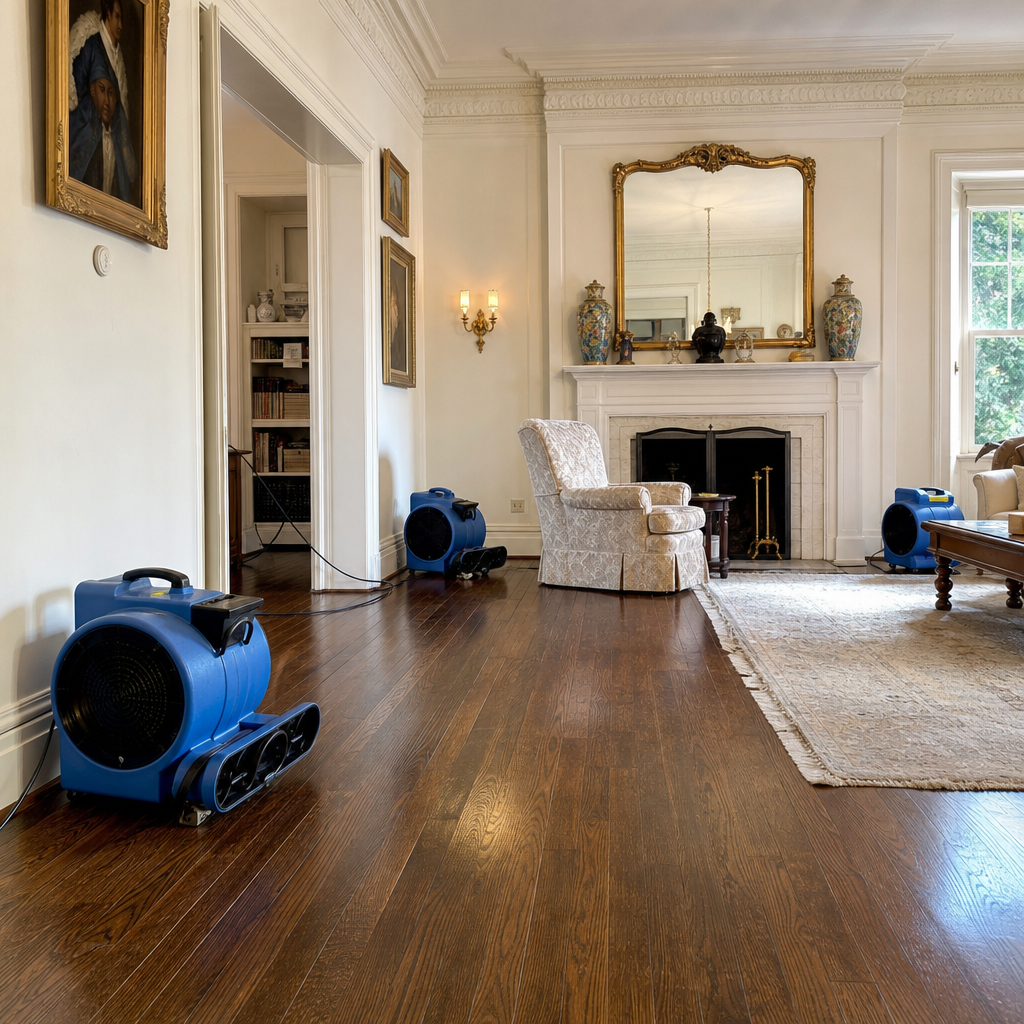
Standard restoration outfits often rely on “rip and replace” tactics, gutting wet rooms down to the studs. While wet modern drywall loses structural integrity quickly and must often be cut away, historic plaster-and-lath behaves completely differently. Plaster is a dense, mineral-based material that does not disintegrate in water. The danger to plaster is not the water itself, but the trapped moisture behind the wall that rots the wood lath and rusts the iron fasteners holding the keys in place.
Plaster-and-Lath vs. Modern Drywall Drying Dynamics
In standard industry restoration practice, historic lath assemblies often undergo controlled, high-volume air exchange through hidden wall cavities rather than aggressive demolition. By creating small access ports behind baseboards and using negative-pressure wall cavity drying systems, restoration specialists like Floodline Restoration Co. pull warm, dry air down through the wall cavities. This extracts moisture from the backside of the plaster keys and the wood lath without cracking the surface finish.
| Drying Metric | Standard Rapid Tear-Out | Ambient Air Movement | Directed Cavity & Mat Systems |
|---|---|---|---|
| Historic Plaster Preservation | Destroyed and removed | High risk of hidden dry rot | Dried in place; retains structural keys |
| Hardwood Floor Cupping | Floorboards stripped and discarded | Slow; results in permanent crowning | Pulls moisture from subfloor; reverses cupping |
| Demolition Footprint | Extensive structural debris | None initially | Minimal (confined behind baseboards) |
| Drying Speed | Fast (due to open framing) | Unpredictable and slow | Fast, targeted, and verified by meters |
Targeted Cavity Injection and Hardwood Mat Systems
When original oak or maple hardwood floors absorb water, the bottom of the board expands faster than the top, causing the edges to curl upward (cupping). Sanding cupped floors while they are still damp ruins them permanently, because once the subfloor dries, the boards shrink and crown.
Industry-standard restoration methods commonly utilize a systematic drying sequence to save subfloors and finished hardwoods:
- Thermal imaging and moisture mapping: Infrared cameras locate the general boundaries of trapped moisture beneath finished flooring and behind plaster. Penetrating and non-penetrating moisture meters establish baseline readings.
- Vacuum floor mat extraction: Heavy-duty floor mats are sealed directly over the wet hardwood. Vacuum units draw air through the floorboard seams, pulling moisture out of the tongue-and-groove joints and the subfloor beneath.
- Low-grain refrigerant (LGR) dehumidification: Industrial LGR or desiccant dehumidifiers reduce ambient relative humidity below 30%, pulling water vapor out of structural timbers and circulating dry, heated air.
- Daily moisture tracking: Technicians log psychrometric readings daily (temperature, relative humidity, and grains per pound) until materials reach their regional equilibrium moisture content (typically around 8% to 12% for hardwoods in the region).
What Does Emergency Water Damage Restoration Cost in Eastchester?
Need emergency water damage restoration in Eastchester?
We’re available now - call for a fast, free estimate.
Restoration pricing is determined by standard industry software (such as Xactimate) used by property insurance carriers. Costs depend on the source of water, the degree of contamination, the square footage involved, and the drying equipment needed.
Eastchester Water Restoration Pricing Breakdown
| Restoration Service Category | Scope of Work & Equipment Required | Typical Cost Factors |
|---|---|---|
| Category 1: Clean Water Extraction | Supply line leaks, water heater failures. Surface extraction, placement of LGR dehumidifiers and high-velocity air movers. | Square footage, number of equipment days required, accessibility of subfloors. |
| Category 2 / Basement Ground Surge | Sump pump failures, surface runoff seepage. Extraction, antimicrobial wash, targeted floor drying mats, cavity drying. | Contamination level, drying difficulty of basement framing, personal property pack-out. |
| Category 3: Sewage & Black Water | Drain backups, severe storm flooding. Full containment barriers, hazardous waste removal, disposal of porous goods, HEPA air scrubbing. | Mandatory PPE, antimicrobial treatments, structural sanitization, hazardous waste disposal fees. |
According to the National Oceanic and Atmospheric Administration (NOAA), severe storm and flood disaster events across New York continue to generate substantial property losses annually. Delaying mitigation allows clean water to degrade into contaminated water and materials to deteriorate further.[3]
Navigating Insurance Adjusters and Carrier Claims
Most standard homeowners policies cover sudden and accidental water discharges (such as a burst copper pipe or cracked washing machine hose), but exclude overland flooding or exterior groundwater unless you carry a dedicated flood policy or sewer backup rider. A reputable restoration partner like Floodline Restoration Co. works directly with your insurance adjuster, providing room-by-room photographic evidence, moisture logs, and itemized billing to keep your claim moving without administrative delays.[4]
Frequently Asked Questions About Eastchester Water Damage Restoration
How long does the residential structural drying process take?
Across the restoration industry, standard residential drying projects typically range between 3 and 5 days. Clean water on modern framing may dry more quickly, while dense plaster-and-lath assemblies, multi-layered subflooring, or crawlspaces generally take longer, often requiring 5 to 7 days or more of continuous dehumidification and air movement. Moisture levels are tested throughout the process to confirm materials have reached acceptable drying standards before equipment is removed.
Does homeowners insurance cover burst pipes and storm backups?
Standard homeowners insurance generally covers sudden and accidental water damage, such as a burst pipe, frozen line, or failed appliance. Damage caused by long-term, unaddressed leaks is typically denied. Water that backs up through sewers or drains usually requires a specific “Water Backup and Sump Overflow” endorsement, while storm surge or surface floodwater requires a separate NFIP or private flood insurance policy.
How do professionals prevent mold growth after water damage?
Mold prevention depends heavily on drying speed and humidity control. Restoration technicians generally aim to lower indoor relative humidity below 50% within 24 to 48 hours using commercial dehumidifiers, apply EPA-registered botanical or commercial-grade antimicrobials to framing, and run HEPA air scrubbers to capture airborne spores during the drying process.
If your Eastchester home or commercial space is taking on water, immediate professional extraction and structural drying from providers like Floodline Restoration Co. protect your property’s value, structural integrity, and architectural heritage.
Need emergency water damage restoration in Eastchester?
We’re available now - call for a fast, free estimate.
Sources
- DiNapoli: Extreme Weather and Disaster Response Costs Rise in NY – osc.ny.gov (2025)
- Severe Weather Events and Resiliency in New York State – osc.ny.gov (2024)
- [PDF] 9.9 Town of Eastchester – SECTION 1: INTRODUCTION – planning.westchestercountyny.gov (2014)
- Flood Insurance Data – Agents Floodsmart – agents.floodsmart.gov
- Flood Response and Substantial Damage in New York State – dec.ny.gov
Related reading: Emergency Water Damage Restoration in Bronxville | 10% Off & Free Estimate | On-Site in 60 Minutes
Related reading: Water Damage Restoration in Mamaroneck – 10% Off & Free Estimate – Same-Day Service
Related reading: Water Damage Restoration in Glen Cove – 10% Off & Free Estimate – Same-Day Service
Frequently Asked Questions
How quickly can emergency water damage restoration crews arrive at my Eastchester home?
Floodline Restoration Co. provides a rapid 45-minute on-site emergency response across Eastchester when you contact our 24/7 live dispatch team. Our certified specialists arrive equipped to perform an immediate free visual inspection, conduct thermal moisture mapping, and halt active water migration.
How does Floodline Restoration Co. handle water damage insurance claims in Eastchester?
We provide complete insurance claim coordination by compiling comprehensive thermal imaging records, daily moisture logs, and itemized Xactimate estimates. Our team works directly with your insurance adjuster to substantiate all structural drying and sanitization procedures, eliminating unnecessary out-of-pocket delays.
Can historic plaster walls and cupped hardwood floors be saved without tearing them out?
Yes, Floodline Restoration Co. uses non-invasive vacuum floor mats and directed wall cavity drying systems engineered to salvage historic building materials in Eastchester homes. These targeted systems extract moisture from lath framing and subfloors to reverse hardwood cupping and preserve plaster integrity without invasive demolition.
About the author
 |
Sarah O’Connor Sarah is an IICRC-certified Water Damage Restoration Technician with over eight years of experience managing residential and commercial property emergencies. She holds a Bachelor of Science in Environmental Science from SUNY Purchase, which informs her approach to safe and effective mold remediation and decontamination. Sarah specializes in creating clear, actionable guides to help property owners navigate emergency recovery and the complexities of insurance claims. |
Water damage, flood, or mold emergency?
We’re available now - call for a fast, free estimate.
Call Now - Free Estimate