
XPOWER Water Damage Restoration in New Rochelle: A Homeowner’s Guide
XPOWER air movers and dehumidifiers can absolutely dry out a wet basement or a soaked carpet, but the machine is only as good as the person reading the moisture meter behind it. In New Rochelle, where Long Island Sound keeps the air heavy with humidity well into October, knowing which XPOWER unit to use, where to place it, and when the job is actually finished means the difference between a dry room and a mold problem that shows up six weeks later. If you’d rather not sort all that out yourself, call (845) 456-6568 and we’ll handle the drying from first reading to final clearance.
Here’s the part most rental counters won’t tell you: a $180 weekend rental of an XPOWER air mover looks like a money-saving move until the drywall behind your baseboard tests at 28% moisture content three weeks later. At that point the mold remediation bill runs three times what proper drying would have cost from day one. We see this pattern regularly in New Rochelle homes, especially in the older stock near Beechmont and along the water, where framing lumber has been soaking up coastal humidity for decades.
What XPOWER Equipment Actually Does (And What It Can’t)
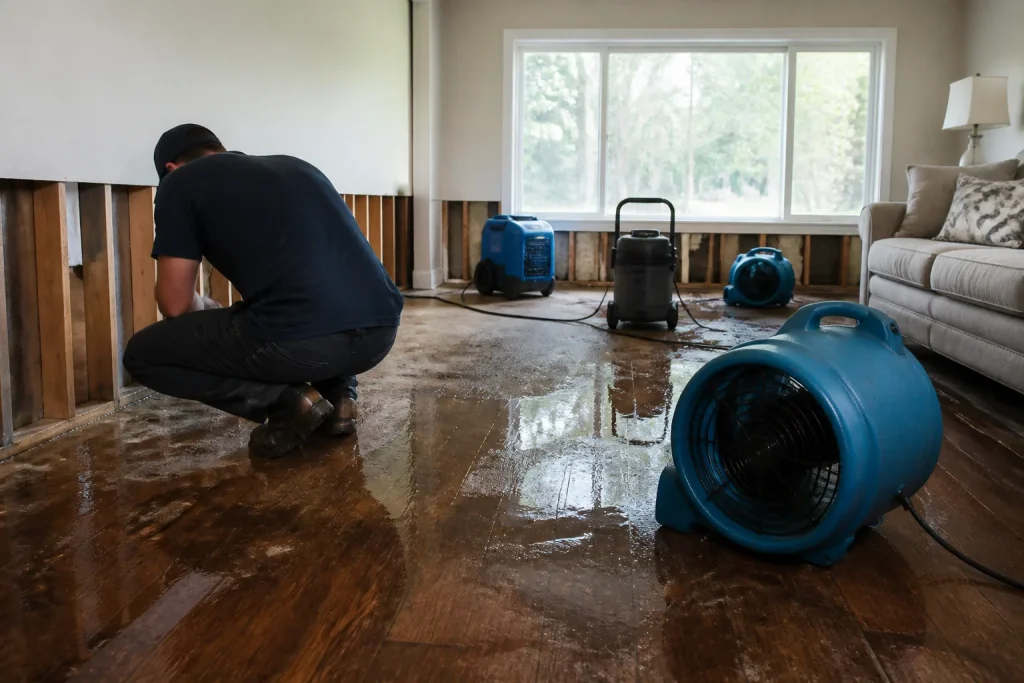
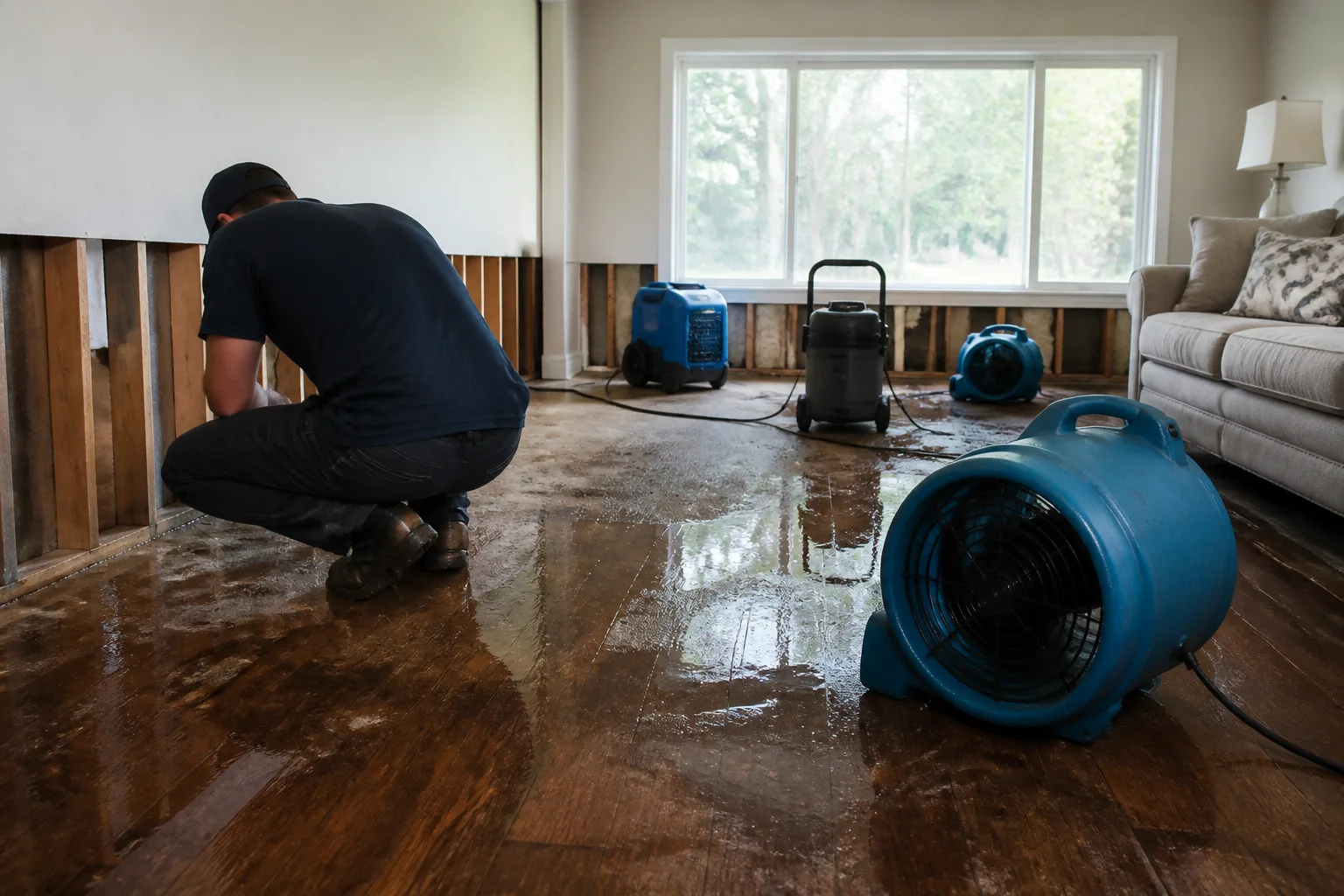
XPOWER builds professional-grade air movers, dehumidifiers, and air scrubbers. The company’s air movers are workhorses. A unit like the XPOWER X-400 runs around 1/3 horsepower, pushes roughly 2,600 cubic feet per minute (CFM), and is built to run continuously for days without overheating. That’s real equipment. We use XPOWER units on flood jobs across New Rochelle, and they hold up.
But CFM ratings are meaningless without context. An air mover’s job is to create airflow across wet surfaces, which forces moisture to evaporate into the air. Evaporation only helps if that moisture then goes somewhere, and that’s where the dehumidifier comes in. An XPOWER dehumidifier rated to pull 50 pints per day at AHAM standard conditions will pull far less in a cold, damp New Rochelle basement. AHAM ratings are measured at 80°F and 60% relative humidity. Most post-flood spaces in Westchester County homes sit closer to 65°F and 75% humidity, where dehumidifier performance drops by 30 to 40 percent. A homeowner who rents any unit by its box rating, not by the cubic footage of the room and the ambient humidity, is guessing. And guessing with water damage means mold wins.
New Rochelle’s Coastal Humidity Works Against You
New Rochelle sits on Long Island Sound, and that geography matters more than most homeowners realize when it comes to drying. Ambient relative humidity in coastal Westchester runs 10 to 20 points higher than inland areas from June through November. That’s not a small detail. It changes drying math.
Here’s the problem in plain terms: a wet room only dries when the air around the wet surfaces is drier than the surface itself. If the outside air blowing in through a cracked window is already 70% humid, it’s not helping. It’s feeding the problem. That’s why certified drying crews in New Rochelle keep windows closed, run dehumidifiers sized to the room’s cubic footage, and measure vapor pressure on both sides of every wall and floor assembly. A rental unit running in an open, humid room will spend its energy drying the outside air, not your studs. We’ve measured it on jobs in the Shore Road area and up toward Wykagyl: houses where a homeowner ran a rental unit for four days, felt the carpet on top, declared it dry, and then called us back because the baseboard had started to swell. The surface was bone dry. The wall cavity behind it was still at 26% moisture content.
The Moisture Numbers That Matter (Per ANSI/IICRC S500)
The restoration industry does not leave “dry” up to touch, smell, or opinion. The ANSI/IICRC S500 Standard and Reference Guide for Professional Water Damage Restoration sets clear targets. For wood framing and structural lumber, the dry standard is a moisture content at or below 16%. For gypsum wallboard (drywall), it’s 5 to 12%. For most carpets and flooring materials, the target depends on the material, but the principle is the same: drying is declared complete only when readings across a statistically representative sample of the affected area are below the standard and stable across consecutive readings.
A single surface reading with a pin meter on the face of a wall tells you almost nothing about what’s happening inside the cavity. Pin meters measure between two surface probes. A non-invasive meter measures deeper, but still cannot verify what’s trapped behind a vapor barrier or inside a void. A real structural drying log in New Rochelle includes daily readings from multiple points: the surface, the wall cavity if open, the base plate behind the trim, the subfloor beneath the carpet, and the sill plate in the basement. On a recent job in the Pinebrook Heights area, the surface of the drywall read 11% by day three. The sill plate behind it read 22% on day three and didn’t hit 15% until day seven. A rental unit sitting in the corner does not know to check the sill plate. A certified technician does.
What a Certified Crew Does Between Equipment Placements
Drying is not a set-it-and-forget-it process. On a typical water damage job in New Rochelle, a Floodline Restoration Co. crew does the following over three to five days:
- Day one: Extract standing water, remove unsalvageable wet materials, set containment, place air movers and dehumidifiers based on a moisture map of the affected area, and establish a baseline reading log.
- Days two through four: Return daily to reposition equipment as wet zones migrate. Water in a wall cavity wicks into cooler, denser materials over time. The wet zone moves. Air movers have to move with it or they dry the wrong spot.
- Throughout: Adjust dehumidifier placement and negative air pressure based on daily readings. If vapor pressure in the room drops too fast, surfaces seal and trap moisture inside. Too slow, and the clock ticks against you for mold germination, which begins at 24 to 48 hours in humid Westchester conditions.
- Final visit: Pull a full set of readings from the moisture log, compare them to the S500 dry standard, and confirm stable readings across two consecutive days. Only then is the job declared dry.
That is work a rented machine cannot do. It has no meter. It has no log. It has no sense of where the water went after it left the surface. We use XPOWER equipment on our own jobs. The equipment is not the variable. The technician behind the equipment is.
The Moisture Log: Documentation Your Insurer Can Actually Verify
If you rent a machine and dry the space yourself, you have no paperwork. That matters more than most homeowners think, because a future mold claim or structural concern depends on proof. An insurer looking at a water damage claim wants evidence that the drying was done to standard. A moisture log is that evidence.
Our crews hand homeowners and their insurance carriers a written record that includes every moisture reading taken, every equipment adjustment made, and the final clearance number that triggered the drying certificate. That’s the difference between saying “it’s dry” and being able to show the numbers. On a job off Pelham Road, we handed a homeowner a log that showed her adjuster the exact day the wall cavity under the bathroom dropped below 16%. The claim closed. She didn’t have to argue expert opinions. She had numbers, with dates, signed by a certified technician.
Rental unit drying produces zero documentation. No readings. No standard. No proof. For a New Rochelle homeowner planning to stay in the house another twenty years, that’s not a savings. That’s a gamble.
When to Call a Pro (And When Rental Makes Sense)
For a small, contained spill, a rented XPOWER unit can make sense. Say a washing machine hose burst, you caught it immediately, the water never reached the walls, and you’ve pulled back the flooring to expose the subfloor. Set the unit up, run it for two days, and check the framing with a meter you buy or borrow. If it reads below 16% across the affected area, you’re probably fine.
Call a professional when any of the following apply:
- Water has touched drywall, baseboards, or wall cavities anywhere in your New Rochelle home.
- The water source is sewage, groundwater, or anything that came in through a foundation breach.
- You smell anything earthy or musty in the days after the event, even if surfaces feel dry.
- There’s any chance water traveled under flooring, behind cabinetry, or into a finished basement ceiling.
- Your insurance company will be involved. A drying log protects the claim.
We pulled an XPOWER air mover out of a garage over in Sutton Manor last week where the homeowner had rented it for a basement leak. He’d run it for five days and the concrete slab felt dry. But the bottom plates of the finished walls behind his wet bar had been soaking the whole time. By the time we opened the wall, the framing was black. The full mold remediation in New Rochelle bill was four times what the water damage restoration work would have cost on day one.
If the job involves fire or smoke exposure on top of water, that’s a separate conversation. Our fire and smoke damage restoration services in New Rochelle handle combined jobs where the drying work and the smoke mitigation have to run in sequence, with the same crew carrying the whole thing through from cleanup to rebuild. You can read more about how all of this fits together on the Floodline Restoration Co. home page.
The Bottom Line
XPOWER equipment is legitimate. We use it, and we’re glad to say so. But a machine is not a plan. It’s one component in a drying strategy that depends on knowing the cubic footage of the affected space, matching dehumidifier capacity to New Rochelle’s coastal humidity patterns, taking daily moisture readings from multiple depths, repositioning equipment as the wet zone migrates, and documenting everything to an S500 standard that an insurance adjuster can verify. Rent the machine if the job is small and contained. Call a certified crew if the water has touched anything structural. If you’re in New Rochelle and need help, Floodline Restoration Co. offers free estimates. Call (845) 456-6568 and a live person will answer, day or night.
Frequently Asked Questions
Yes. XPOWER builds professional-grade air movers, dehumidifiers, and air scrubbers that hold up to continuous multi-day use. The equipment’s performance depends on proper sizing and placement, which is why certified technicians match unit capacity to the cubic footage of the affected space and the ambient humidity of the room.
Cost varies by the size of the affected area, the category of water, and the number of days the drying process requires. Most New Rochelle water damage jobs where walls or flooring are involved run between $1,800 and $6,000 when performed by a certified restoration company. A weekend XPOWER rental alone might cost $150 to $300, but it includes no moisture monitoring, no documentation, and no drying guarantee. Call (845) 456-6568 for a free estimate specific to your situation.
With properly sized equipment and daily monitoring, most interior rooms in New Rochelle reach the S500 dry standard in three to five days. Coastal humidity can extend that timeline by a day or two compared to inland Westchester. Structural cavities behind drywall and under flooring typically take longer than exposed surfaces, which is why daily cavity readings matter.
In most cases, yes. Homeowners policies cover water damage restoration when the loss is sudden and accidental, and that includes the cost of the drying equipment and the technician hours required to operate it. The key is documentation. A certified crew provides an itemized drying log that supports the claim. Call (845) 456-6568 and we’ll work directly with your adjuster.
Written by Curt Bowman, Owner at Floodline Restoration Co., serving New Rochelle since 2010.
Need Damage Restoration Help?
Call Floodline Restoration Co. - licensed & insured, here with fast after-hours help in New Rochelle.
(845) 456-6568